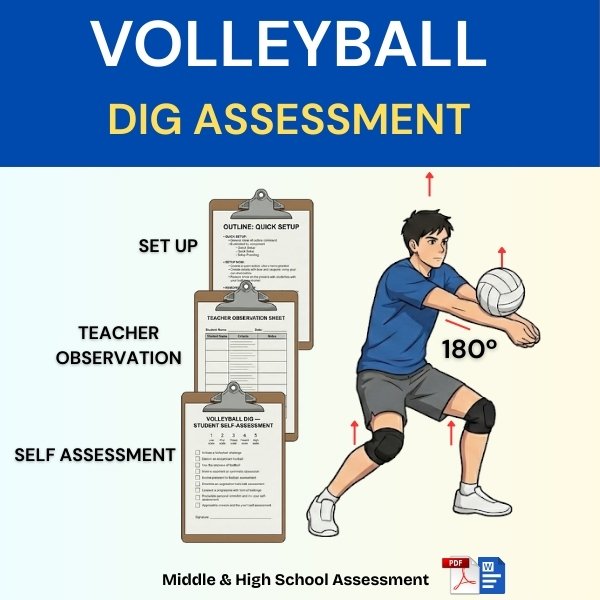
Looking for a quick, printable volleyball dig assessment that actually works in a real PE class? This free resource gives you a teacher observation sheet and a student self-assessment you can use in 8–12 minutes (or as a 5–7 minute quick check). It’s designed for middle school and high school PE (Grades 6–12) and helps you assess both skill technique and simple game-ready habits like communication and control.
✅ Free classroom content in this post
🧾 Want the printable documents? Grab the downloadable sheets on Teachers Pay Teachers
A strong dig (forearm pass) is the foundation for everything that follows in volleyball—set, attack, and rally play. This assessment focuses on what teachers can actually see quickly:
Ready position and moving to the ball (feet first)
Platform and clean forearm contact
Angle and control (no wild swings)
Accuracy to a target
Communication and teamwork (“Mine” + respectful feedback)
Set up: Partner Toss → Dig to Target
Put students in pairs facing each other.
One student uses an underhand toss to the passer.
The passer performs a dig aiming for a target (hoop, cone, marked zone).
Assess 10 attempts per student, then switch roles.
High School: 16–23 ft (Adjust based on your space and skill level.)
Assessment criteria
Use these criteria to score students on a 1–4 scale and check what you see consistently (about 7/10 attempts).
A) Performance score (1–4)
1 — Beginning: inconsistent platform/contact, limited control
2 — Developing: some correct reps, inconsistent footwork or targeting
3 — Proficient: usually ready, solid platform, controlled direction
4 — Advanced: consistent control + accurate targeting + strong habits
B) What to look for (quick checklist)
Ready & move: low ready position, moves feet to get behind the ball Platform & contact: flat platform, contacts on forearms (not hands) Angle & control: sends ball up/forward, controlled contact (no swing) Accuracy: hits the target zone consistently Communication: calls “Mine,” gives respectful feedback
Student self-assessment
Have students rate themselves using: 1 Not yet | 2 Sometimes | 3 Usually | 4 Always
“I can start in a low, athletic ready position.” “I can move my feet to get behind the ball.” “I can make a flat platform with my forearms.” “I can angle my platform to send the ball toward a target.” “I can communicate (‘Mine’) and work with my partner.”
1-minute reflection:
My strength today: _________
My one improvement cue: ☐ Feet early ☐ Flat platform ☐ Angle to target ☐ Call “Mine”
Common mistakes (and quick fixes)
Reaching instead of moving: “Feet first—get behind it.”
Bending elbows: “Arms straight—strong platform.”
Wild swings: “Quiet arms—controlled contact.”
No direction: “Angle your platform to the target.”
Yes. Use the middle school modifications (shorter distance + bigger target) and focus on footwork + platform first.
How do I grade quickly with 30 students?
Assess half the class while the other half is tossing/collecting. Rotate after 5 attempts. You can score a student in 15–20 seconds once the drill is running.
Do I need nets?
No. This is a skill-focused assessment that works in any gym.