AI in Physical Education: Fitness Testing to a Personalized 4-Week Training Unit (8 Lessons)
Table of Contents
Toggle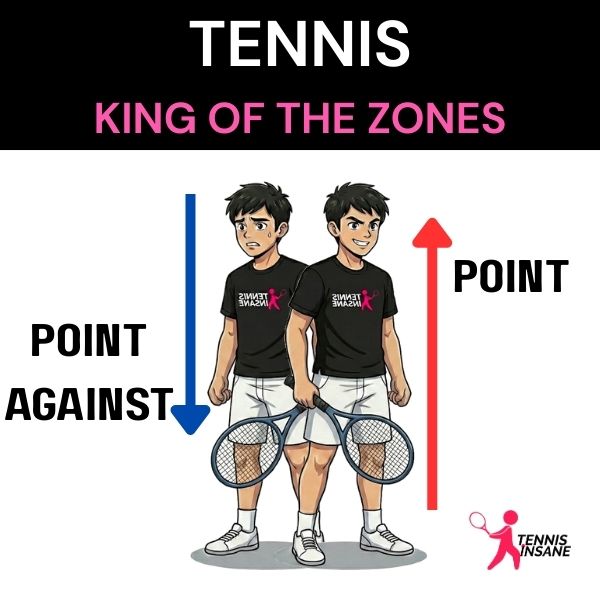
If you teach a tennis unit in PE (or coach beginners through advanced players), you’ve probably noticed two things:
Students love competition, and
Tennis can create too much standing around if the format isn’t tight.
This King/Queen of the Court tennis game fixes both.
It’s a simple, high-engagement point-play format where students “climb” through three court zones—baseline, midcourt, and net—earning points by winning consecutive rallies. It’s perfect for Middle School PE (Grades 6–8) and High School PE (Grades 9–12) because it naturally teaches:
Footwork and recovery (they must adjust position after every rally)
Attack vs. defense decision-making
Finishing points at the net
Competitive behavior: focus, resilience, and quick transitions
Want the Student Worksheet + Class Presentation Templates?
$9.99 $4.99
- Tennis Coach
- Presentation PDF
- Set up
- Variations
- Coach Tips
What is this game?
Think of it as King/Queen of the Court + progression zones.
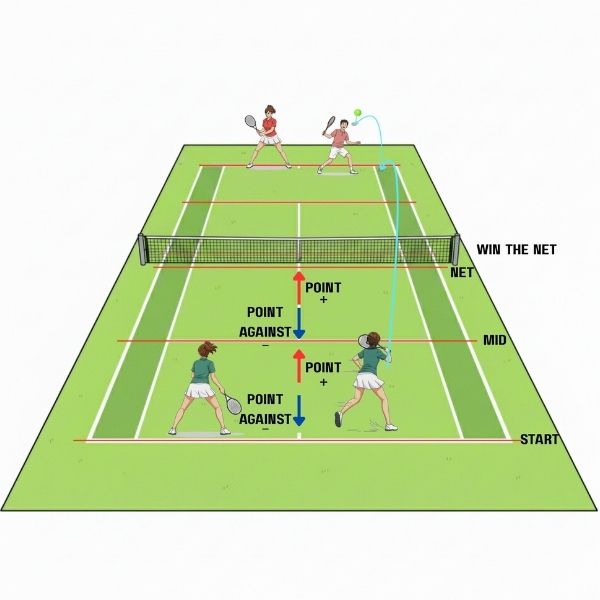
Win a point at the baseline → you move up to midcourt
Win again → you move up to the net
Win a third point at the net → you score 1 point and reset to baseline
Lose a point? You drop back one zone.
It creates a clear “level-up” system students understand instantly—and it keeps everyone motivated.
Equipment & setup (PE-friendly)
You need:
Tennis racquets (or paddle/racket alternatives if needed)
Tennis balls
Low-compression (red/orange/green) for beginners
Regular balls for intermediate/advanced
1 court (or half-court / taped lines in a gym)
Best group size:
Works great with 2–6 players per court
If you have more students, run multiple courts/stations or use a rotation (see “Large classes” below).
Court zones:
Define 3 zones on each side:
Baseline zone (start)
Midcourt zone (around service line area)
Net zone (volley/finish)
You don’t need extra lines—just tell students where they stand to start each rally.
How to play (rules)
Step 1: Start at the baseline
All players begin in the baseline zone.
Step 2: Play a point
A point begins with a teacher feed or a simple underhand toss/serve to keep it moving.
Step 3: Move up or down based on the result
If you win the point: move forward one zone
Baseline → Midcourt → NetIf you lose the point: move back one zone
Net → Midcourt → Baseline
Step 4: Score a point at the top
If a player wins three points in a row (one in each zone) and wins the point while in the net zone, they earn 1 point and reset to the baseline to try again.
Teacher/coach feeding rule (recommended)
To keep transitions clean, the teacher (or a designated feeder) puts the ball in play for the player/team who just lost the previous point. This avoids arguments and keeps the tempo high.
Why this works so well in Middle & High School PE
1) It teaches “when to attack”
Students feel the shift from rallying safely at baseline → stepping in at midcourt → finishing at the net.
2) It improves footwork without “footwork drills”
Because they’re constantly changing zones, they’re forced to:
split-step
recover
read the ball
adjust spacing
3) It gives everyone a fair chance
Even less skilled students can win baseline points if you use:
low-compression balls
slower feeds
smaller court constraints (service boxes only)
Variations
Beginner-friendly variations
Allow 2 bounces (especially in baseline zone)
Service boxes only (mini-tennis) to improve control
No volleys required at the net: just “finish inside the court”
Challenge variations (intermediate/advanced)
No lobs (forces creative passing shots and net play)
Double points for a focus skill
Example: “Backhand winner = x2” or “Drop shot winner = x2”Feed to winners, not losers (faster pace, more pressure)
Add a 4th zone: “defensive zone” behind baseline (great for advanced footwork and deep-ball defense)
PE behavior / communication add-ons
Give a bonus point for:
calling the score correctly
quick reset and ready position
sportsmanship (hand up, quick “my bad”, etc.)
Large classes? Here are 3 easy ways
Option A: 2 courts + rotation
4–6 active per court
Others are:
feeders
line judges
scorekeepers
Rotate every 3–4 minutes.
Option B: King/Queen ladder lines
Set two “challenge” lines. Winners move up the ladder, losers move down. Keeps 10–14 students involved with minimal downtime.
Option C: Station format (best for PE)
Run:
Zone King/Queen game (this one)
Serve target station
Rally consistency station
Volley wall/partner station
Rotate every 6–8 minutes.
FAQ
What is King/Queen of the Court in tennis?
A rotating competition format where winners stay on or move up, and others rotate in/out. It’s popular because it’s fast and motivating.How do you run tennis in PE with big classes?
Use stations, low-compression balls, short courts (service boxes), and clear rotations (feeders/scorekeepers) to reduce wait time.What tennis games work best for middle school PE?
Games with short points, clear progress rules, and lots of touches—like zone-based King/Queen formats, Around-the-World rallies, and winner-side point play.
Want the full pack?
This is Game #1 from my 10 Tennis Practice Games & Drills for PE (Middle School & High School) resource. If you want 10 plug-and-play tennis games with objectives, variations, and coaching tips—grab the full bundle on TPT.
$9.99 $4.99
- Tennis Coach
- Presentation PDF
- Set up
- Variations
- Coach Tips