
Stick Together, Break Away (Running Circuit Game)
Table of Contents
ToggleS1 (Motor Skills), S2 (Movement Concepts), S4 (Personal & Social Behavior)
Want a running activity that builds pacing, awareness, and a fast finishing kick—without boring laps? Stick Together, Break Away is a simple athletics circuit for PE where students run in groups of 4, moving as a pack until you call “Break away!”—then it turns into a short race.
It’s perfect for middle school and high school PE because it teaches:
Pace control (not going out too hard)
Group awareness (staying with teammates)
Speed change (trot → sprint)
Competitive fun (without complicated rules)

Learning targets (I can…)
Maintain a steady pace while running with my group.
Stay connected to my group by matching the fastest safe pace.
Accelerate on cue and sprint with good mechanics for the final laps.
Recover quickly between rounds and repeat quality effort.
How to Play
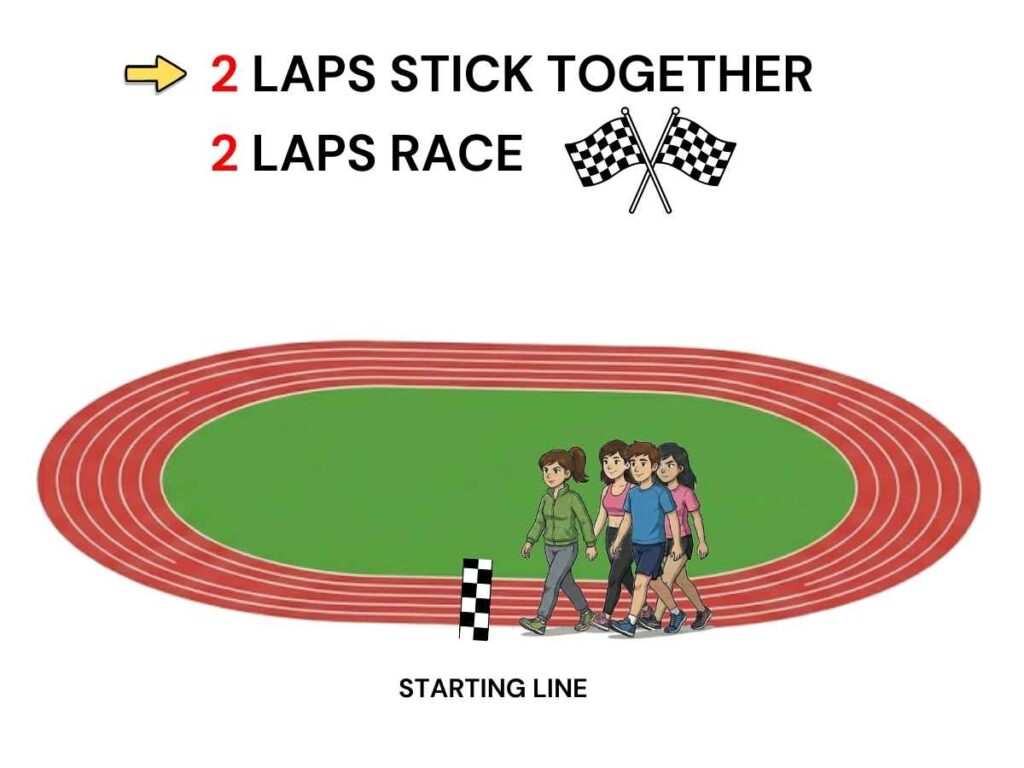
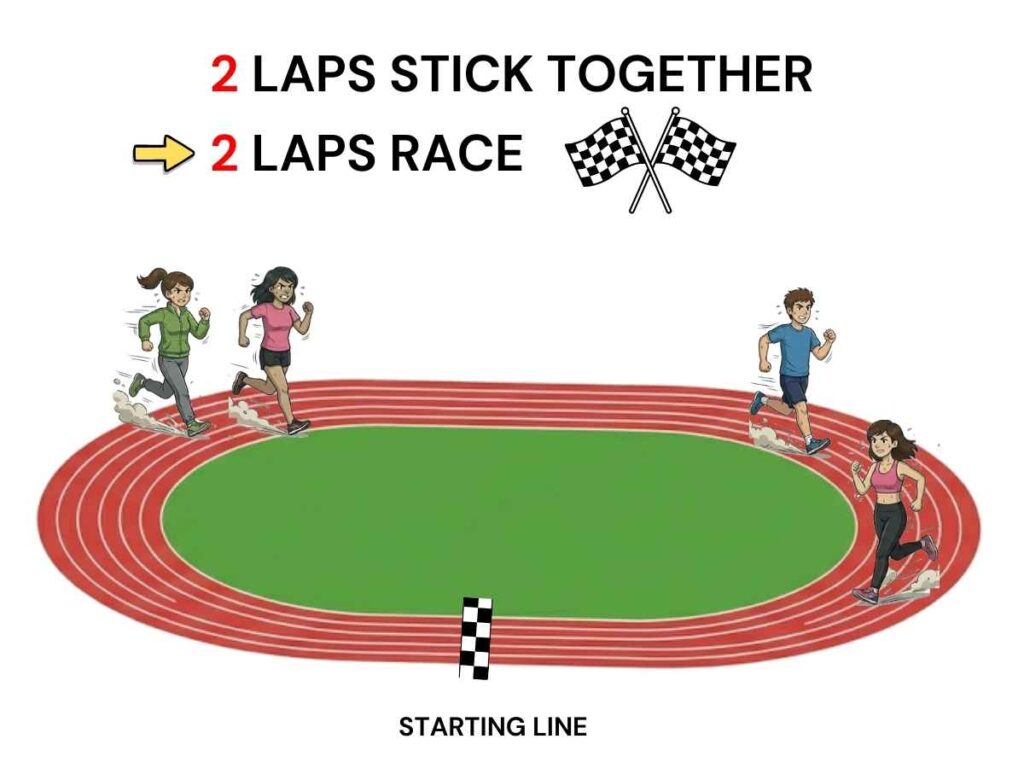
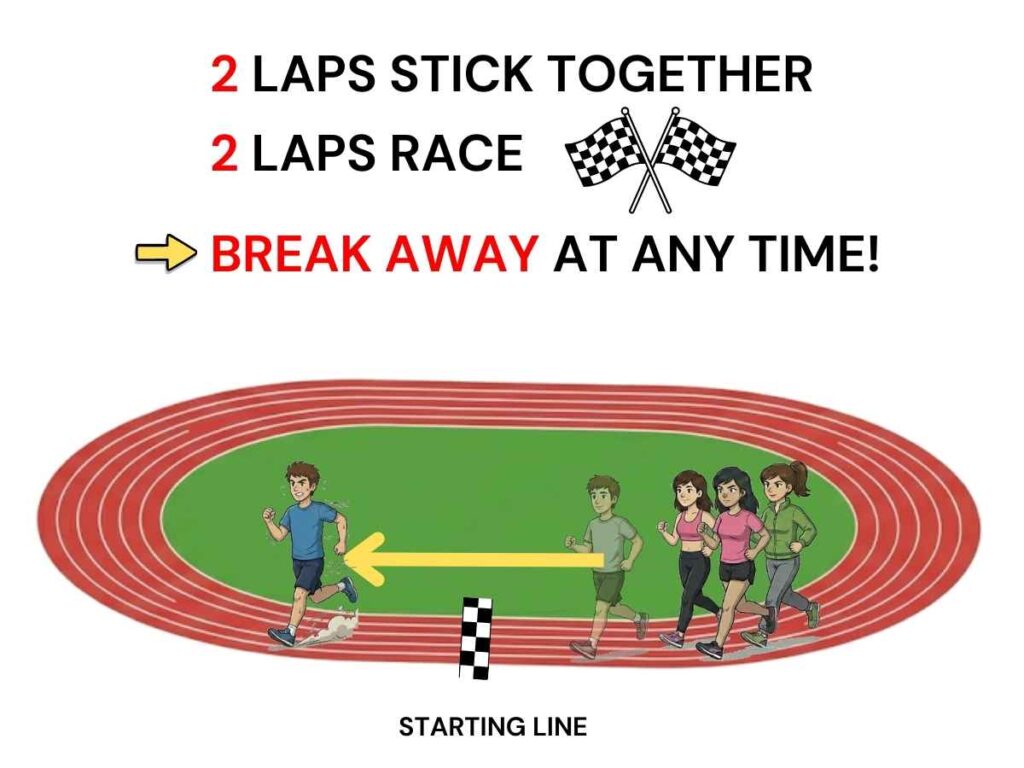
The key rule
During Stick Together, students must stay together as one group:
-
They can walk or jog.
-
They must match the pace of the fastest safe runner in their group.
-
If someone can’t keep up, they fall behind (natural consequence).
(This creates a real pacing challenge and makes teamwork matter.)
The race portion
When you call “Break away!”:
-
The round becomes a race for the remaining laps.
-
Students sprint with control (no contact, no cutting people off).
Rounds Format:
Run the circuit in rounds. Each round has a Stick Together phase + a Race phase.
Round 1
-
2 laps Stick Together
-
2 laps Race
Round 2
-
3 laps Stick Together
-
1 lap Race
Final Round (the surprise finish)
This is the one students remember.
-
Start the round in Stick Together, but do not tell them how many laps.
-
Keep them moving as a pack (walk/jog).
-
At a random moment, call: “BREAK AWAY!”
-
Immediately they race 2 laps to finish.
Why it works: They must stay mentally ready, hold a sustainable pace, and react instantly when the sprint begins—like a real race situation.
Variations
Change the split
1 lap stick + 3 race
3 stick + 2 race
4 stick + 1 race (hard pacing challenge)
Change the “break away” rule
Silent break: you raise a hand instead of saying it
Whistle break: one whistle = break away
Double break: break away → regroup → break away again
Add strategy
Each group chooses: walk faster now or save energy for sprint
Give each group one “surge” during stick together (10 seconds faster pace)
Space-limited version (small gym/field)
Use a shorter loop and call them “laps”
Make race phase 30–45 seconds instead of 2 laps
Lower-impact version
Stick together = fast walk
Break away = controlled jog to finish
FAQ
What is “Stick Together, Break Away” in PE?
It’s a running circuit game where students jog or walk as a group during the “stick together” phase, then race when the teacher calls “break away.”
What grades is this running game best for?
It works best for grades 6–12 (middle school and high school), but you can simplify it for upper elementary by shortening the circuit and reducing race distance.
How many students do you need?
It’s designed for groups of 4, but it also works with groups of 3–6 if you have uneven numbers.
Do students have to run the whole time?
No. During “stick together,” students can walk or jog as long as they stay with their group. The race portion is when they run fast.
How long does the activity take?
Most classes can run it in 12–20 minutes, depending on how many rounds you do and how long your rest periods are.
What’s the best space to run it?
A 400m track is ideal, but any marked loop on a field, blacktop, or large gym works if students can safely move in one direction.
How do you stop the track from getting crowded?
Stagger group starts by 5–10 seconds, assign lanes/spaces, and require passing only on the outside during the sprint phase.
How do you make it easier for beginners?
Use a shorter loop, allow walking during “stick together,” reduce the race to 1 lap (or 30 seconds), and increase rest time.
How do you make it more challenging?
Add more rounds, shorten rest, require jogging only during “stick together,” or add a second surprise “break away” call.
Is this good for fitness testing or conditioning?
Yes—this is an excellent conditioning game because it trains aerobic pacing plus short, high-effort sprints, similar to many field and court sports.